FTTH installation continues to expand as fiber to the home networks grow across rural, suburban, and urban markets. But how those networks are built often depends on where you are.
We sat down with Ron Petrie, Regional Account Manager – North Central U.S., and Kieser Hladik, Regional Account Manager – Central U.S., at Precision Group to discuss what they are seeing in their territories. The conversation centered on regional construction differences, long-term maintenance planning, and how installation strategy shifts as markets mature.

Regional Differences in FTTH Installation
When planning an FTTH installation, providers first determine how fiber optic cables will reach the home. The decision is driven by geography, cost and existing infrastructure.
In the North Central U.S., underground deployment remains dominant.
“In our region, we install almost everything underground,” says Petrie.
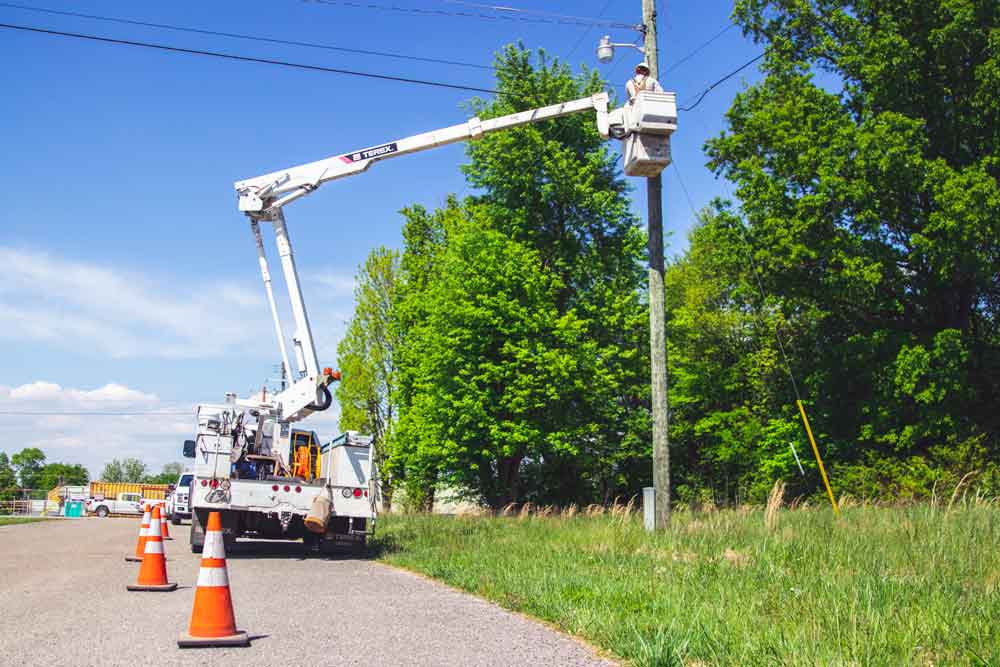
In other territories, aerial deployment remains common, particularly where cooperatives already own pole infrastructure.
“There’s still a fair amount of aerial, especially for cooperatives that already own their poles,” shared Hladik.
The trade-offs are practical:
Underground builds
- Require drilling and trenching
- Face higher costs in rock-heavy terrain
- Involve restoration and repair considerations
- Protected from environmental conditions
Aerial builds
- Require engineering for wind, snow, and ice loads
- Depend on pole ownership and access
- Expose fiber optic cables to environmental conditions
- Faster Speed of Deployment
Providers compare cost per foot, engineering complexity, access for maintenance and long-term operational impact before committing to a build method. These capital decisions shape how optical fiber reaches the home.
Why Demarcation Matters in FTTH Installation
Regardless of whether the drop is aerial or underground, every FTTH installation requires a defined transition between outside plant and interior wiring.
The Network Interface Device (NID) sets that boundary.
“In my territory, we install a NID on almost every home,” Petrie says. “It’s an ideal test access point.”
Hladik sees the same trend.
“They like having that junction there,” he says. “If fiber is ever damaged inside the house, they can just run a new jumper instead of pulling fiber all the way through again.”
When service issues arise, technicians rely on a controlled location to test and isolate the problem.

With a properly configured fiber NID:
- The fiber drop is terminated in a protected enclosure
- Connections are shielded from weather exposure
- Technicians can isolate outside plant from interior wiring
- Interior fiber damage can often be resolved quicker and easier
- Over time, those design decisions directly influence maintenance efficiency and labor costs.
The Optical Network Terminal (ONT) and Interior Install Expectations
Inside the home, the optical network terminal (ONT) converts the fiber signal into usable service.
ONT designs have become smaller and cleaner. As a result, wall plates and structured interior fiber routing have become more common in residential installs.
We’re definitely very heavy NIDs here,” Hladik says.“Wall plates are pretty heavy in my market too. Very few customers are looking to run the fiber all the way into the ONT without a jack or enclosure. Mainly because of trouble calls and truck rolls after damage to the indoor/outdoor fiber or SCA connector.”
Most FTTH installation designs now follow a layered approach:
- Optical fiber reaches the home from aerial or underground plant.
- The drop cable terminates inside an exterior fiber NID.
- A jumper carries the signal to an interior wall plate, ONT enclosure or directly into the ONT.
This structure allows providers to meet interior expectations without sacrificing long-term service access.
Hidden Costs Appear After Installation
Construction speed is easy to measure. Service complexity shows up later. When FTTH installation lacks structure:
- Fiber routing differs from home to home
- Fault isolation takes longer
- Interior access becomes more common
- Repairs require more technician time
Battery Backup and Surge Protection in FTTH Installation
Power strategy at the home has shifted significantly over the past decade.
In earlier fiber-to-the-home builds, battery backup for the optical network terminal (ONT) was often included as part of the standard installation, due to FCC requirements. Today, that approach looks very different.
“When the FCC changed requirements, we did see some providers selling batteries vs providing,” says Petrie. “Instead, they offered battery as part of sales and marketing. More recently we have seen a resurgence of battery backup to limit truck rolls in brownout or simply provide a better level of service than the competition.”
That change is consistent across regions.
Kieser Hladik sees the same trend in his territory.
“When customers don’t offer battery backup, they’re at least protecting their equipment with our ONT surge protection so they’re not sending technicians out for preventable power-related issues.”
From Included Backup to Optional Add-On
In many markets:
- Battery backup is often needed in unstable electrical grids to limit truck rolls, and prevent damage to ONTs from brownouts
- Providers may offer it as an optional upgrade
- Adoption often depends on whether the customer is taking voice service
- Some providers differentiate between territories when deciding how to structure the offering
“It’s a mix out there,” Petrie says. “If the customer is taking a voice line, they’re usually more interested in battery backup. But it’s not automatic anymore.”
Surge Protection Gains Ground
As full battery backup becomes less universal, surge protection has become more consistent.
“I think people are coming around to at least understanding surge protection and covering their own equipment,” Hladik says. “That way they clean up some of the issues they’d otherwise have with power.”
Surge-protected power supplies and plug-in devices provide:
- Protection against power fluctuations
- Reduced truck rolls related to power events
- Lower equipment replacement rates
- A pathway to add battery modules later, if needed
“We still see a lot of surge protection devices moving,” Petrie adds. “Some customers start with surge protection and add a stackable battery later. We are also designing many solutions to allow the customer to manage the battery side themselves while still having the correct amount of surge protection for the ONT.”
Regional Differences, Similar Outcomes
While underground versus aerial deployment varies by geography, the approach to battery backup and surge protection is surprisingly similar across territories.
Providers are:
- More selective about where battery backup is included
- Using Battery as add-on sales or recurring monthly fees for the marketing teams to sell
- Increasingly focused on protecting equipment at minimum
The result is a more intentional power strategy at the home — one that balances cost, customer expectations, and long-term service reliability.
Planning for the Future: Multi-Duct and Capacity Strategy
In underground markets especially, providers are thinking beyond the first fiber pull.
Instead of installing a single pathway and returning later to trench again, many are building additional capacity into the original installation.
“We’re seeing more multi-duct installs,” says Hladik. “That way they’re prepared for the future instead of coming back and plowing again.”
Ron Petrie confirms the same approach in the North Central region.
“Instead of coming back and plowing another duct and another fiber, they can just blow in a new fiber later and save that labor cost,” Petrie explains.
This approach:
- Reduces future restoration costs
- Minimizes customer disruption
- Lowers long-term labor expenses
- Speeds expansion when additional services are required
While the initial installation cost may be higher, the long-term operational savings often justify the decision, particularly in rock-heavy or restoration-sensitive terrain.
Future-proofing the outside plant is not about overbuilding. It is about eliminating repeat construction.
MDU Growth Changes Installation Strategy
In both regions, multi-dwelling units (MDUs) are becoming a larger part of FTTH installation planning.
“I would say MDUs are one of the biggest growth areas,” Petrie says. “But none of them are cookie cutter.”
Unlike single-family residential installs, MDUs introduce variability:
- Interior routing differences
- Unique mounting requirements
- Shared infrastructure constraints
- Custom demarcation layouts
“You can’t have one box that fits all,” Petrie adds.
In some markets, the complexity extends beyond traditional apartments. Rural territories may require service to a home, a detached shop, and even additional dwellings on the same property.
“It’s not always going to look the same,” Hladik explains. “They’ve got to figure out how that rolls into how they’re doing things.”
As MDU builds accelerate, installation flexibility becomes as important as standardization.
Training and Workforce Transition in FTTH Installation
In some markets, fiber-to-the-home has existed for decades.
“In my territory, service providers have been building fiber networks for 20 or 30 years,” Petrie says. “Now we’re starting to see those folks retire.”
As experienced technicians leave, years of field knowledge leave with them.
“You’re losing that network knowledge,” Petrie explains. “That’s going to be a challenge over the next five to ten years.”
When workforce turnover increases, installations must become more standardized. A consistent exterior NID supports:
- Repeatable installation practices
- Clear provider-to-customer separation
- Faster onboarding of new technicians
- Reduced dependence on individual judgment
- Ability to leave ONTs on site with logos and QR codes for self-signup as ONT costs decline
In large-scale FTTH installation, structure protects the network from workforce variability and helps new crews execute with confidence.

Regional Differences, Shared Installation Principles
Regional build strategies will continue to vary
Terrain, cost, pole ownership, restoration requirements, rock conditions, and weather loads all influence how fiber reaches the home. Some territories remain heavily underground. Others continue to rely on aerial plant. MDU growth introduces customization. Multi-duct planning builds in capacity for the future. Power strategy evolves alongside customer expectations.
But while construction methods differ, long-term service realities do not.
Every FTTH installation will eventually be maintained.
Every network will experience technician turnover.
Every provider will manage upgrades, troubleshooting, and service calls long after initial construction.
That is where shared installation principles matter most.
What Remains Constant in FTTH Installation
Across regions, effective FTTH installation consistently includes:
- Clear demarcation between outside plant and interior wiring
- Structured transition points at the home
- Protected fiber terminations
- Intentional power strategy, including surge protection considerations
- Repeatable installation practices that reduce variability
These fundamentals support both day-one installs and year-ten service calls.
Why Installation Standards Matter Long Term
As networks mature, consistency becomes a competitive advantage.
Standardized installation practices support:
- Faster fault isolation and reduced truck rolls
- Easier onboarding of new technicians
- Lower long-term labor costs
- Protection of outside plant investment
- Greater confidence when expanding into new territories
Construction methods may differ. Clear installation standards remain essential.
For providers evaluating their FTTH installation strategy, the question is not only how to reach the home, but how that installation will perform five, ten, or fifteen years from now.
If you are reviewing your current FTTH installation standards or planning expansion in new markets, Precision Group works alongside service providers across diverse territories to support long-term serviceability and field efficiency.
Because in FTTH installation, what stays consistent often matters more than what changes.